

The 4 Seasons of Your Cycle: A Biological Overview
If you’ve ever wondered why some weeks you’re conquering deadlines like a boss, and the next you can’t decide between crying or napping, it isn’t “moodiness.” It’s biology. Think of your cycle not as a monthly "curse," but as a biological year with four distinct seasons. Expecting yourself to have the same energy every day is like expecting a tree to bloom flowers in the middle of winter. It’s not just unrealistic; it’s biologically impossible.
Here is your map to the weather patterns inside your body.
What this article will help you understand:
- The science of the menstrual cycle as a 28-day biological rhythm (beyond “period vs no period”).
- How to interpret a hormone curve, even if you’ve never seen one before.
- Why your motivation, cravings, skin, sleep, and mood genuinely change by phase.
- Practical ways to plan diet, movement, and social/work energy around your inner seasons.
(And once you learn the seasons, you stop fighting your body, and start using it.)
The Science: Your Internal Weather Report
Your cycle has four hormonal phases, orchestrated by two main characters: Estrogen (your energy and social butterfly hormone) and Progesterone (your sedating, detail-oriented hormone). Think of them like emotional-weather forecasts: knowing them helps you plan food, workouts, work meetings, and mood support
1. Winter: The Menstrual Phase (Days 1–5)
- The Vibe: Hibernation.
- What’s Happening: Your hormones (estrogen and progesterone) drop to their lowest levels. Your uterine lining sheds.
- How You Feel: Your energy is naturally low. This is a time of biological reset. Just as nature goes quiet in winter, your body is asking for rest.
2. Spring: The Follicular Phase (Days 6–14)
- The Vibe: Rebirth and blooming.
- What’s Happening: Pituitary hormones signal your ovaries to prepare an egg. Estrogen begins to rise.
- How You Feel: Brain fog lifts. Energy surges. You handle stress (cortisol) well during this time. You might feel lighter, more optimistic, and ready to start new projects.
3. Summer: The Ovulatory Phase (Days 15–17)
- The Vibe: Peak sunshine and socialization.
- What’s Happening: Estrogen hits its peak. Testosterone spikes slightly.
- How You Feel: You are magnetic. Your verbal centers are most active now, making you more articulate. This is when you feel like "Superwoman"confident, energetic, and resilient.
4. Autumn: The Luteal Phase (Days 18–28)
- The Vibe: Winding down and nesting.
- What’s Happening: Estrogen drops, and Progesterone rises.
- How You Feel: Your body shifts into "prepare and protect" mode. Your brain becomes wired for detail and caution rather than big-picture socializing.
- Note: As you near the end of this phase, serotonin (the happy chemical) can drop, leading to emotional sensitivity.
Visualising Your Hormone Wave 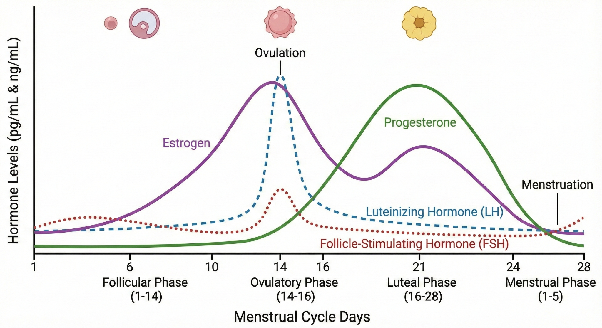
- Estrogen = Energy + Glow + Social Brain
When estrogen rises (Spring → Summer), brain areas linked to confidence and language become more active. - Progesterone = Calm + Caution + Prepare Mode
After ovulation (Autumn), progesterone rises, temperature increases slightly, metabolism accelerates, and cravings are NORMAL: your body thinks it “may need to support pregnancy.”
By late luteal phase, progesterone drops sharply → serotonin drops, which is one reason PMS can feel like someone swapped your brain overnight.
And yes, most traditional routines and health advice ignore this because medical systems historically excluded women from trials until the 1990s
The Fix: Syncing Your Lifestyle
You don't need to overhaul your life; just make small tweaks to match your internal season.
1. Movement: Match the Energy
- Spring & Summer (Follicular/Ovulatory): Your body handles stress well here. This is the time for HIIT, heavy lifting, or spin classes.
- Autumn & Winter (Luteal/Menstrual): Pushing for a "Personal Record" (PR) here can backfire, triggering inflammation. Switch to strength training with longer breaks, Pilates, or Yoga.
2. Productivity: Work Smarter
- Spring & Summer (Follicular/Ovulatory): Schedule high-stakes meetings, interviews, or social outings when your verbal skills are sharpest.
- Autumn (Luteal): Block out "deep work" or solo tasks. Your brain is primed for editing, reviewing, and organising details.
3. Nutrition: Feed the Metabolism
- Autumn (Luteal): Your metabolism actually speeds up (burning ~100–300 extra calories/day).You will crave carbs because your insulin sensitivity changes. Don’t starve yourself. Increase your intake of complex carbs and protein to stabilize blood sugar and mood.
- Winter (Menstrual):Iron loss may cause fatigue.Consume Warm iron-rich foods: spinach dal, rajma, beetroot sabzi, ragi ladoo with jaggery
Indian Context: The "Desi" Swap
Our traditional Indian diet is actually perfectly suited for this, if we use it wisely.
- For "Winter" (Menstruation): Avoid cold foods. Sip on Ajwain water or warm Haldi doodh (Turmeric milk) to combat inflammation.
- For "Autumn" (Luteal Cravings): When that pre-period hunger hits, don't reach for the packet of biscuits. Your body needs complex carbs. Swap the refined flour for Sweet Potato Chaat (Shakarkandi) or a bowl of Dalia (broken wheat). These provide the glucose your brain is begging for without the sugar crash.
Dr. Rove’s Note
If PMS symptoms regularly disrupt work, relationships, or sleep, that’s a clinical sign, not a personal flaw. Track → observe → and speak to a clinician early if something feels “too much.”
References & Further Reading
- Menstrual cycle metabolism (Journal of Physiology)
https://physoc.onlinelibrary.wiley.com/doi/10.1113/jphysiol.2020.195016 - Estrogen & insulin sensitivity (NIH)
https://www.ncbi.nlm.nih.gov/pmc/articles/PMC6691699/ - Progesterone & serotonin (JCEM)
https://academic.oup.com/jcem/article/104/12/5960/5556220 - Stress and menstrual disruption (NIH)
https://www.ncbi.nlm.nih.gov/pmc/articles/PMC7790710/ - Luteal-phase based strength training (SpringerLink study)
https://link.springer.com/article/10.1007/s00421-014-2783-4 - Infradian rhythm & metabolic shifts (Scientific Reports)
https://www.nature.com/articles/s41598-018-30866-3 - Gender data gap: Women excluded from trials (NIH history)
https://www.ncbi.nlm.nih.gov/pmc/articles/PMC3611753/
A note on medical advice
This article is for general education and is not a substitute for professional medical advice, diagnosis, or treatment. Always speak with a qualified doctor about your symptoms, and never start, stop, or change a medication or supplement based on what you read here.


